How to use AI to enable reps to respond to your customer's problems
 Gaurav Harode
The collateral gap is real: Sales enablement gives reps features; prospects demand solutions to problems. Your existing solution-focused content is missing the mark, but Generative AI is here to bridge that distance.
Product marketers, marketing managers, and sales enablement stakeholders know that prospects care about business problems. They do not care about your product and solutions. They want to know whether or not you can address their problems and what that process looks like.
But the majority of the sales enablement collateral is not problem oriented. It talks about the company’s solutions, their products, and features. On one hand marketing is churning out sales collateral to enable reps. And on the other hand prospects are expecting reps to address their business pain points. This created a major enablement gap.
Good news! AI can help. This article discusses how organizations can use AI to equip sales reps to address prospect’s problems. This is achieved by leveraging existing, solution- and product-focused sales and marketing collateral.
Enabling reps for solution selling is difficult
Enabling reps for solution selling is difficult. Though an older piece, this relevant McKinsey article, What’s wrong with solutions selling, still shares valuable insights on this topic.
The sales cycle obstacle
Organizations plan around the sales process. However, the sales process rarely aligns with the buying process. Misalignment with the buyer’s expectations may be a cause. In the modern age, it is impossible to map your B2B sales process to the buying process. The buying process is no longer linear. In fact, it is quite complicated and varies from one buyer to another. Therefore expecting your sales process to align with the buying process is a non-starter.
The “Why us?” focus
If your business has competitors, which almost all businesses do, there is a natural bias to intentionally focus on “Why us?” collateral, not the customer’s challenges. “Why Us?” collateral is required and can be helpful further down the sales process, but this bias unfortunately seeps into most sales collateral.
Practical challenges in creating problem oriented collateral
Here are the practical challenges to creating and maintaining a quality content library that is oriented to solve the market’s problems, not advertise your organization’s offerings.
Multiple buyers, multiple problems - Many solutions touch multiple personas in the buying organization. And every buyer role has their unique challenges that they want to address. It is difficult to segment your collateral to speak to the different buyer persona-relevant challenges.
Knowledge bias - Organizations typically know more about their products and capabilities than the market’s problems. This bias seeps into all aspects of the marketing and sales collateral.
Lack of evangelism - This is closely related to the knowledge bias. Most people in the organizations are working on the product or the offering - either building the product or delivering the services. Either they are building the product or offering the services. A small portion of the organization has a customer’s perspective. Organizations do not evangelize this knowledge around the company.
Content Type Conundrum - Data Sheets, Product Sheets, One Pagers, Pitch Decks, Solution Briefs, Case Studies are common sales collateral formats. Except for case studies, none of the formats are problem oriented. And even case studies rarely go into problem details. Most case studies quote a high-level problem and then dig deeper into the solution.
Not Understanding Granular Problems - Most organizations define the benefits of their solutions well. In the same breath, they will also talk about the problems they address. However, they focus on high-level problems. Lack of Sales Productivity, Poor Analytics, Loss of Revenue—high-level problems that act as a great guiding star but rarely translate to effective sales enablement. In today’s digitally connected world, buyers are well-versed with high-level problems. They increasingly need help with low-level problems that add up to the high-level problem. My reps cannot send email on the go is a better problem to address than “Lack of Sales Productivity”.
Generative AI to the rescue
AI offers a huge opportunity to flip the script and significantly improve sales enablement without investing in new collateral. With AI, organizations can take their existing sales & marketing collateral to enable their reps to address customer problems. They can turn their reps from feature pitchers to problem solvers. Not only that, but they will do so without investing in additional collateral, and saving sales reps time.
We will use a real world example to explain the “how”.
The hurt locker
One of our enterprise customers is an auto dealership software company that serves a wide array of solutions for the dealerships in North America. They have always trained their sales reps to focus on their customer’s problems and be a problem solver. However, if you look at their collateral, it was focused on solutions, capabilities, and past successes. And though the content was written from a customer’s perspective, reps struggled to connect the dots between a dealership’s specific problems and how they solved those problems.
We used generative AI to bridge this gap.
Identifying candidate content types
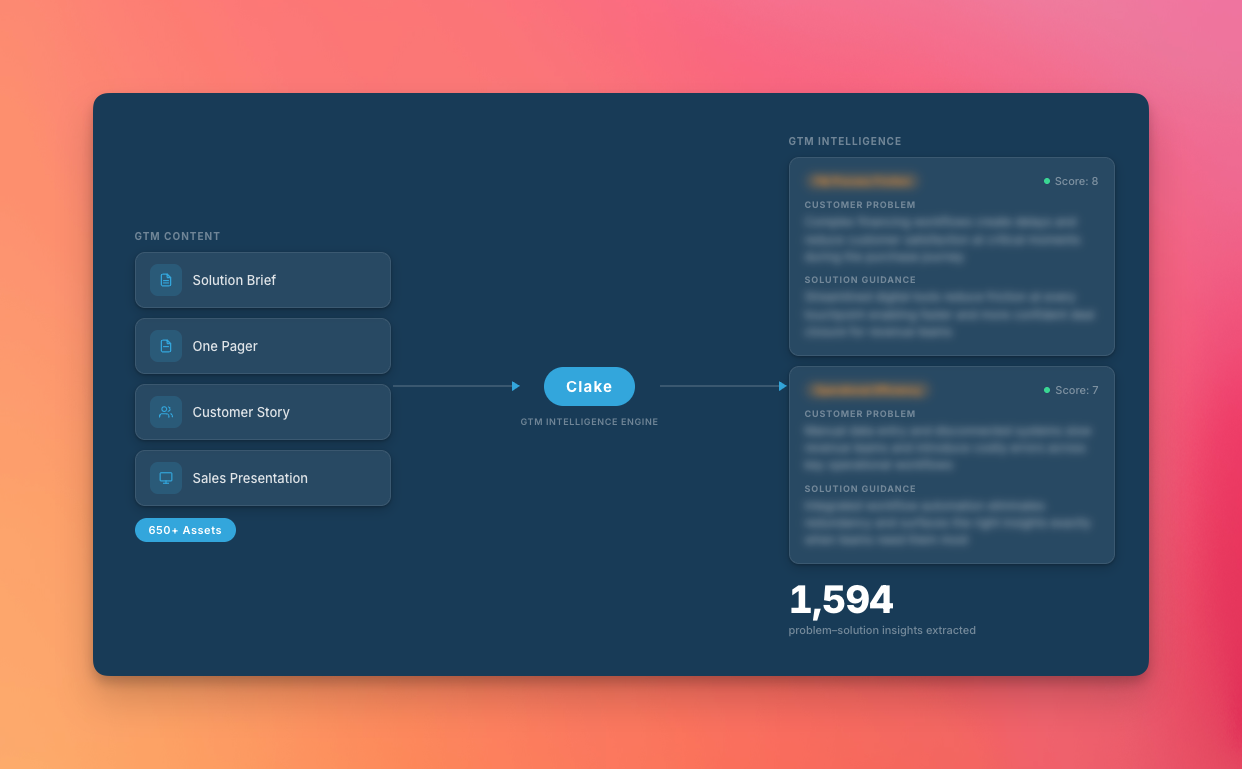
The company had a strong quality content library. For the initial scope, we focused on four different content types: One Pagers, Solution Briefs, Sales Presentations, and Customer Stories.
Why these?
They had quality coverage of the company’s varied solutions and offerings
Content assets of these types had already been vetted for sharing externally. Therefore, they posed no risk of accidentally exposing confidential information to the prospects and customers.
The sales enablement stakeholders knew that if they cracked the code with this set of collateral, they could easily add on additional assets to build a complete solution.
For this project we had 600+ assets for the scoped content types.
The market context
There are several definitions for market context. In the age of AI, everyone is touting the value of context. In this example, market context means,
Profile of the target market.
What types of problems the market has that this company solves. For this project, we called these Hurt Categories.
Note that this is no internal secret sauce stuff. This is the information that Claude or ChatGPT can tell you in less than 30 seconds. But it is an important guide for this exercise.
This was a quick exercise in this project. The go-to-market team may even already have this data handy for use.

Additional context
In addition to the hurt categories, we also captured additional context as it relates to the domain. For example, we identified other elements:
Department: The relevant dealership department for a specific pain point
Role: The relevant persona/role for a specific hurt
High Level Goal: The high level business goal that is related to a hurt
Regional Relevancy: Is this a universal problem in North America or specific to USA or Canada
The intelligence extraction step
This is the vital step where modern advancements in generative AI are instrumental.
We processed each of the 600+ content items and extracted zero or more customer hurt insights. What is a hurt insight? It includes:
A customer hurt statement that is addressed by the asset
A 2-3 sentence description that describes the problem statement
Relevant customer hurt category
Company’s Solution: How does the company address this hurt
One or more departments that are impacted by this hurt
One or more roles that are impacted by this hurt
High level goal related to this hurt
We used Clake to extract these insights. And ended up with almost 1600 hurt insights. It was time to equip reps with guidance to address their customer pain points.
Enablement flow 1: Customer hurt solver
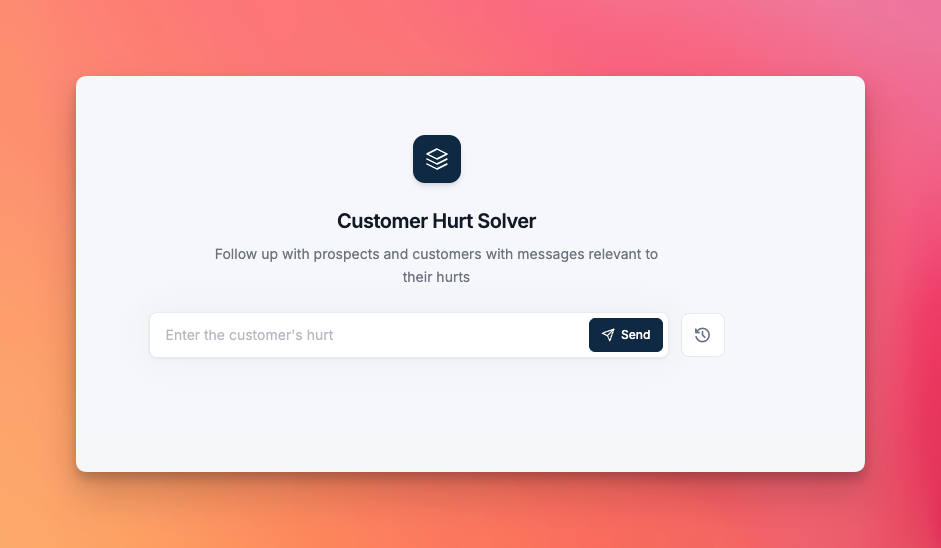
Once the team extracted and segmented the insights by categories, roles, departments, and goals, the sales enablement team was ready to arm the reps with targeted guidance to help prospects address their problems. The first quick win was Customer Hurt Solver.
A simple conversational experience where reps could enter their prospects' hurt and get prescriptive advice on how to position the company’s offering to address that hurt.
No more content dump, no more second guessing. Only targeted guidance specific to a customer’s hurt.
Enablement flow 2: Automated hurt guidance
The sales operations team had recently activated the Salesforce Account Plan feature, and customer hurts was a key component. Sales leadership was doing everything to get reps to enter customer hurts in their account plans. The Hurt Locker project presented a massive opportunity to drive adoption of account plans and deliver value to sales reps.
Rep enters customer hurt(s) in Salesforce Account Plan and receives an enablement brief for those hurts in email. Massive win-win. It was a no-brainer next step.
Enablement flow 3: Build a deal room (Roadmap)
We do not want to stop at prescriptive guidance. We want to use the opportunity to reduce a rep’s non-selling time. Reps at this organization are accustomed to meeting customers and following up with targeted microsites and deal rooms. We now have the opportunity to automate a big part of that process. If rep is already hurting in Salesforce, why not also send them an almost ready deal room to share with the prospect.
Imagine the time savings and the impact on rep productivity. Plus you will have more reps following this best practice when they don’t need to go through the motion of building the deal room. It is an obvious next step that we look forward to activating.
What does this mean for your hurt locker?
Implementing this project was an aha moment. For a long time, organizations have struggled to define what AI means for sales enablement. There are a number of individual workflows and use cases that surface up on this topic. And there is always the allure of a sales assistant chatbot. The chatbot approach does not work. Your reps do not know what questions to ask and how to ask them.
This project helped us build a targeted AI powered sales enablement use case.
The problem we solved for our customer is universal—just the industry and the domain are different. And this organization does not use call recording software. Imagine if they had Gong or Chorus! You could automate the entire flow without requiring the rep to change their behavior.
The question you should ask yourself is: How to accomplish this outcome within your organization? Whether you use Clake or an in-house AI pipeline, the time to unlock your Hurt Locker for better sales enablement is now.
Sales enablement content to sales enablement outcomes
In an industry tired with content slop, AI can help deliver sales enablement outcomes
Subscribe to Enablix
Fresh thinking on sales, partner and customer enablement, delivered to your inbox.