Should you train sales reps for better prompting skills
 Gaurav Harode
Quick Answer: A sales rep using a well thought out prompt definitely saves time and “tokens”. However, training reps for better prompting is a tough endeavor that is likely to be an enablement time sink, that will not deliver the expected upside and that will result in downsides that are easy to miss and not obvious to the revenue stakeholders.
Key Takeaways
Training sales reps on prompt engineering is an enablement time sink with low ROI and hidden downsides.
Modern AI models and grounded agents easily handle short or unstructured prompts.
Changing rep behavior is extremely difficult as reps naturally seek the path of least resistance.
Interactive, multi-turn AI conversations provide a superior, subconscious guided learning experience for reps.
Enablement stakeholders should avoid wasting time on prompt training and instead rely on advanced AI capabilities.
In the initial months of generative AI, the discipline of prompt engineering was popular. The consensus was that if you write a good prompt, the AI service will give you a more accurate and complete answer. Therefore, as revenue teams are investing in AI tools and equipping reps with AI assistants, there is a desire to equip reps with prompting skills to deliver an accurate and complete AI-powered enablement experience.
However, a lot has changed since the early innings of generative AI that has weakened the case for investing time and energy in training reps with better prompting skills. There is more to lose than to gain in spending energy in training reps on prompting.
Writing better prompts has its advantages but an enablement stakeholders time is better spent in other activities than training reps on how to write a better prompt.
AI Models Have Advanced
AI models have advanced significantly. With the right context of your organization, they can figure out what the rep is wanting to ask. And even when a rep does not provide much information, it can guide the rep in the right direction.
We will discuss these scenarios with the help of a couple of examples.
Example 1: Two word prompt (very limited details from the rep)
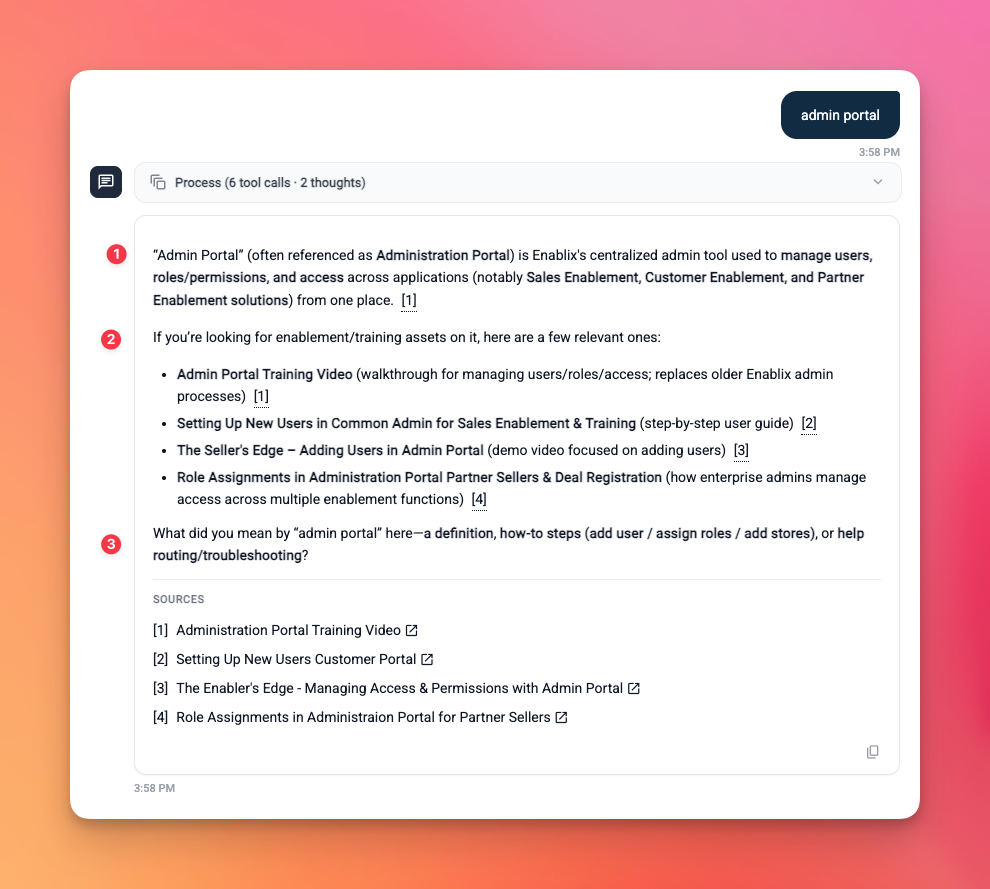
Let's analyze the sales companion agent’s response.
The sales companion agent made a best guess estimate about what the user is talking about based on the two worded prompt. This is the advantage of grounding your AI agents in the organization's context.
And then it assumes that its guess is likely true and goes on to provide information about the “Administration Portal”. It is worth highlighting that it focuses on training/enablement assets for the administration portal. Here too, the over enablement context is at play.
And to close it out, the sales companion agent prods the user to provide more information to better understand the user’s request (given the very limited information provided by the seller).
In most scenarios, this answer will suffice. The AI agent will likely identify the correct topic and provide generic information about that topic as well as surface key content assets (as the Sales Companion Agent did in the above example). And it will leave room for doubt if the user wants to provide more details.
Example 2: Imperfect Prompts (Reps sharing their train of thought)
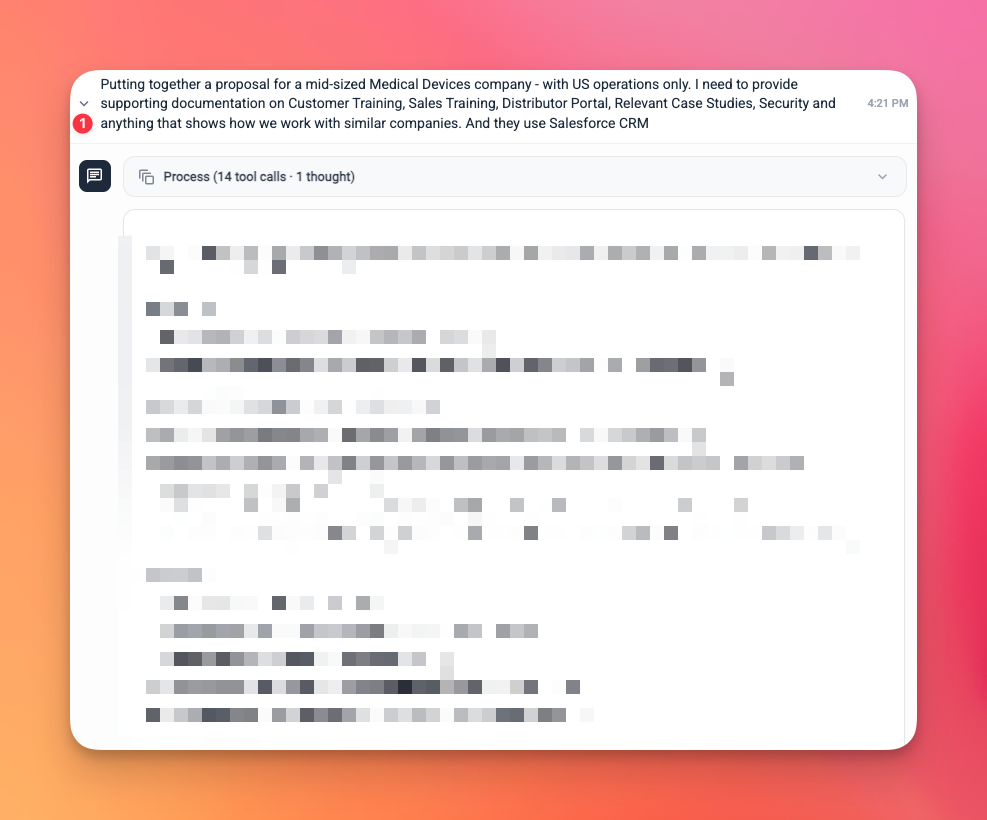
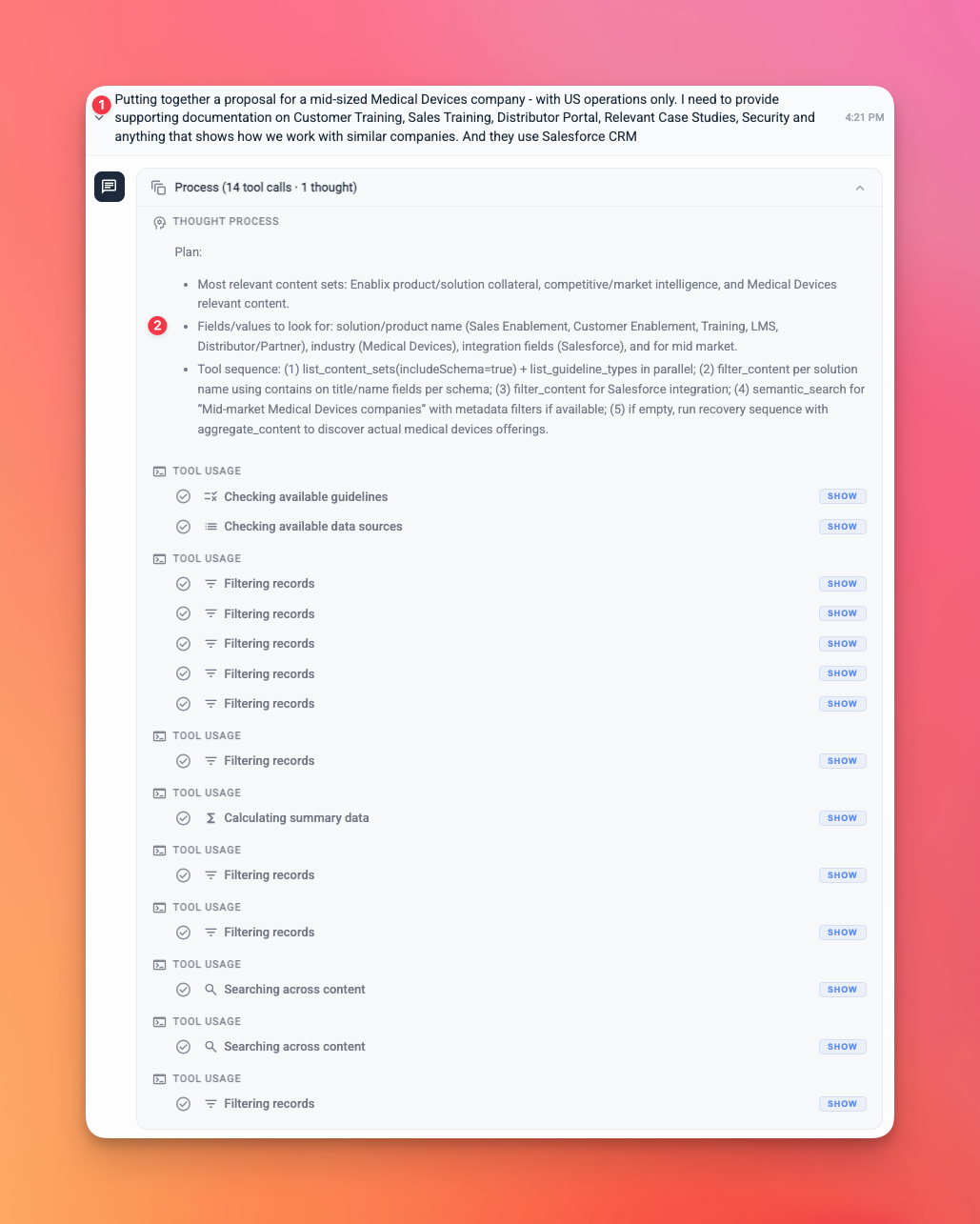
Let's analyze the sales companion agent’s response.
The rep shared their train of thought and sprinkled it with details of the prospect in no particular order or priority. The AI agents are smart enough that it can handle much poorer formatted information easily.
Instead of focusing on the answer, in this example we will focus on the sales companion agent’s thought process. Here are noteworthy points.
As the rep asked about supporting documentation, the AI agent planned to focus on product/solution collateral.
And since it is a proposal, the AI agent also planned to look into competitive and market information, if available.
The agent clearly differentiated between solutions and offerings from prospect profile information (e.g. Industry is Medical Devices). And it was able to figure out that Salesforce was an integration topic and not an offering.
If you look closely at the sequence of the tools, you will get further insight into how the AI agent planned to go about gathering the requested information.
With the right setup and grounding, prompts with very little information or prompts with poorly formatted information are no problem. AI advancements, especially their ability to reason, overcomes the downside of poor prompts and will get the job done for the rep.
Changing Rep Behavior Is Hard
If the last decade of sales enablement has taught us anything, it is that changing rep behavior is very hard. Sales reps operate in a high pressure environment and are likely to avoid learning any new skill unless it gives them outsized advantage.
Reps are likely to take the least effort to get the job done. As we saw in the previous section, we find way more one and 2 word prompts amongst our customer users than well explained prompts. Reps are already inundated with so much information. Adding skills to prompt better is not likely to stick.
A prerequisite for writing a good prompt is having all the information upfront. And in the majority of the instances reps do not have that information. Or even when they do, they haven’t considered that information as pertinent to their question. You will be burdening the reps before they get any help.
Missing The Opportunity To Learn
A non-obvious advantage of using AI to discover information is that it guides the user based on the context.
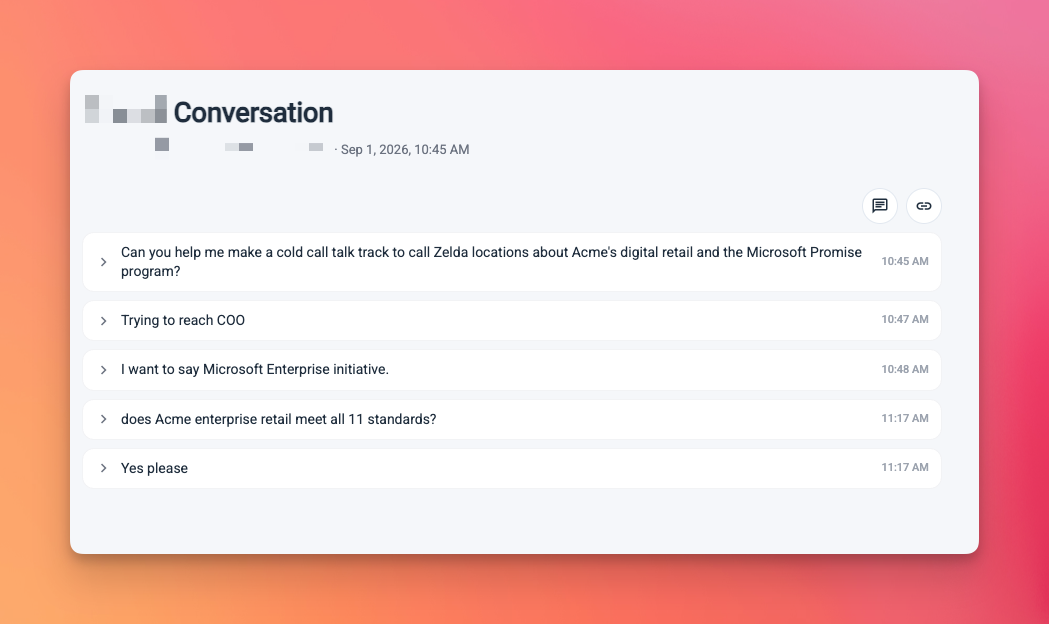
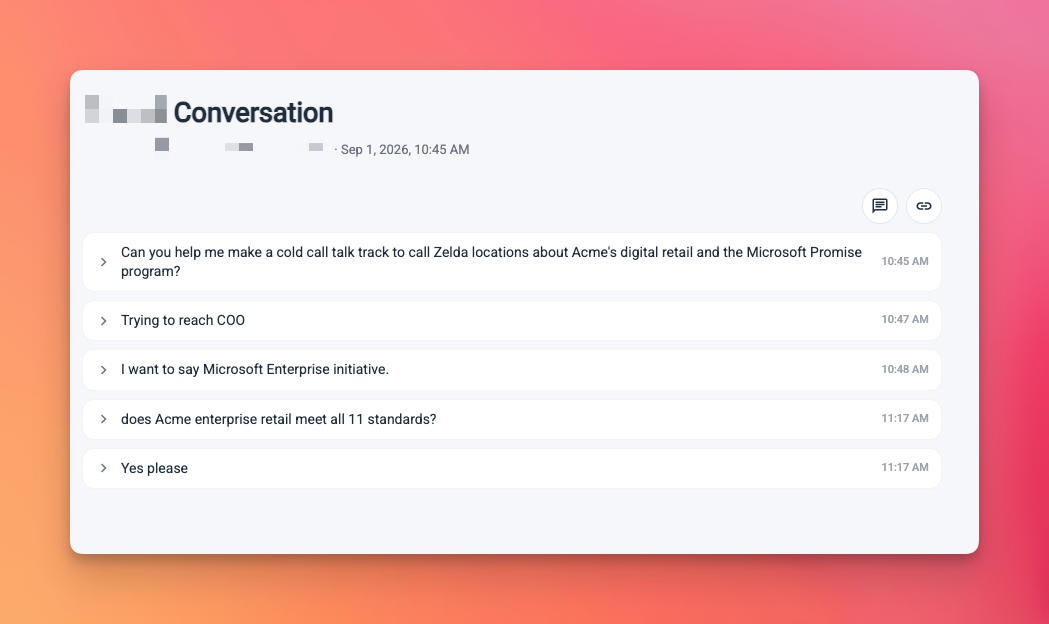
In the below example, the AI agent provided a best-guess answer and asked the user to share further context in order to refine the response.
Conversation Summary
Guided Flow
1/5 Can you help me make a cold call talk track to call Zelda Storeships about Acme digital Digital and the Zelda Enterprise program?
The above is an animation of the details of the conversation. The confidential data is masked. The best way to use this video is to stop the animation and observe the unmasked text. The conversation demonstrates how the AI agent guides the sales rep through their options.
We believe this is a superior learning experience for the sales rep. Unconsciously they are being trained to think about their business in a certain way. And that too in the context of a session initiated by them.
We already discussed how asking reps to write a near-perfect prompt requires them to consider all the information upfront. Conversely, going through a conversation with an AI agent not only results in a natural flow that reps will prefer, it also, along the way subconsciously trains the rep about the different ways of approaching the business.
The Bottom Line
There is very little upside in spending time and energy to train reps on writing better prompts. With the advancement in AI agents' reasoning knowledge, poorly formed prompts as well as prompts with very little information can help guide the reps to the ultimate answer. And while these multi-step processes may require a little more time and burn more tokens, the long term benefit of guiding a sales rep through this information journey is worth the time and tokens.
Enablement stakeholders should encourage reps to write single shot prompts when reps know the entire context rather than provide information in a piece meal fashion. However, sinking time and energy in prompt training is not worth the effort.
Subscribe to Enablix
Fresh thinking on sales, partner and customer enablement, delivered to your inbox.