From sales enablement content to sales enablement outcomes
 Gaurav Harode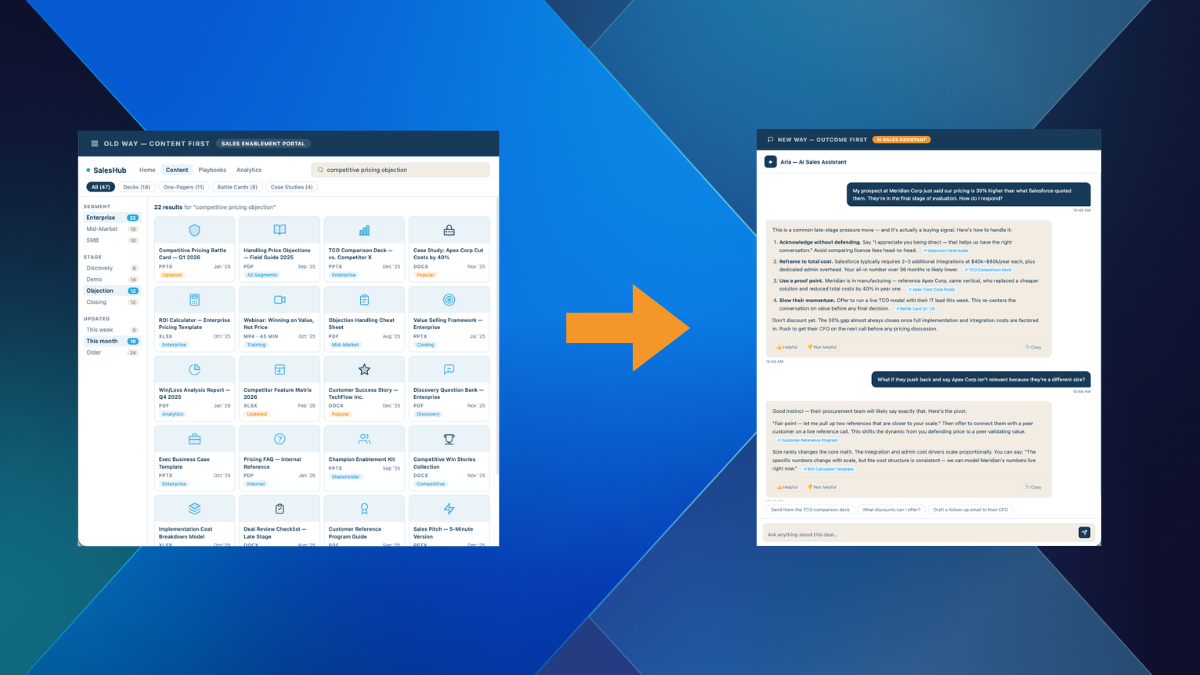
The purpose of a sales team is to grow revenue. Sales Enablement is about growing revenue.
In early 2021, we wrote the What is Sales Enablement post we provided the following outline:
Its primary objective is enabling salespeople to close deals faster.
Sales enablement equips the sales team with resources to help buyers in the buying process.
Sales enablement resources include research, tools, and best practices that sales will consume and content that will help buyers with the buying process.
Besides providing necessary resources, sales enablement also ensures that salespeople can use these resources.
Sales enablement also measures effectiveness using data and KPIs to improve the sales process.
If you dissect this outline from 2021, three themes emerge:
Enabling buyers and sellers with content
Enabling sellers with using the content and resources
Tracking effectiveness of content
Content is central to a sales enablement program. Go to market practitioners and sales enablement managers have invested in preparing training materials, pitch decks, product videos, discovery question templates, objection handlers, one pagers, customer stories to equip the sellers and to inform the buyers.
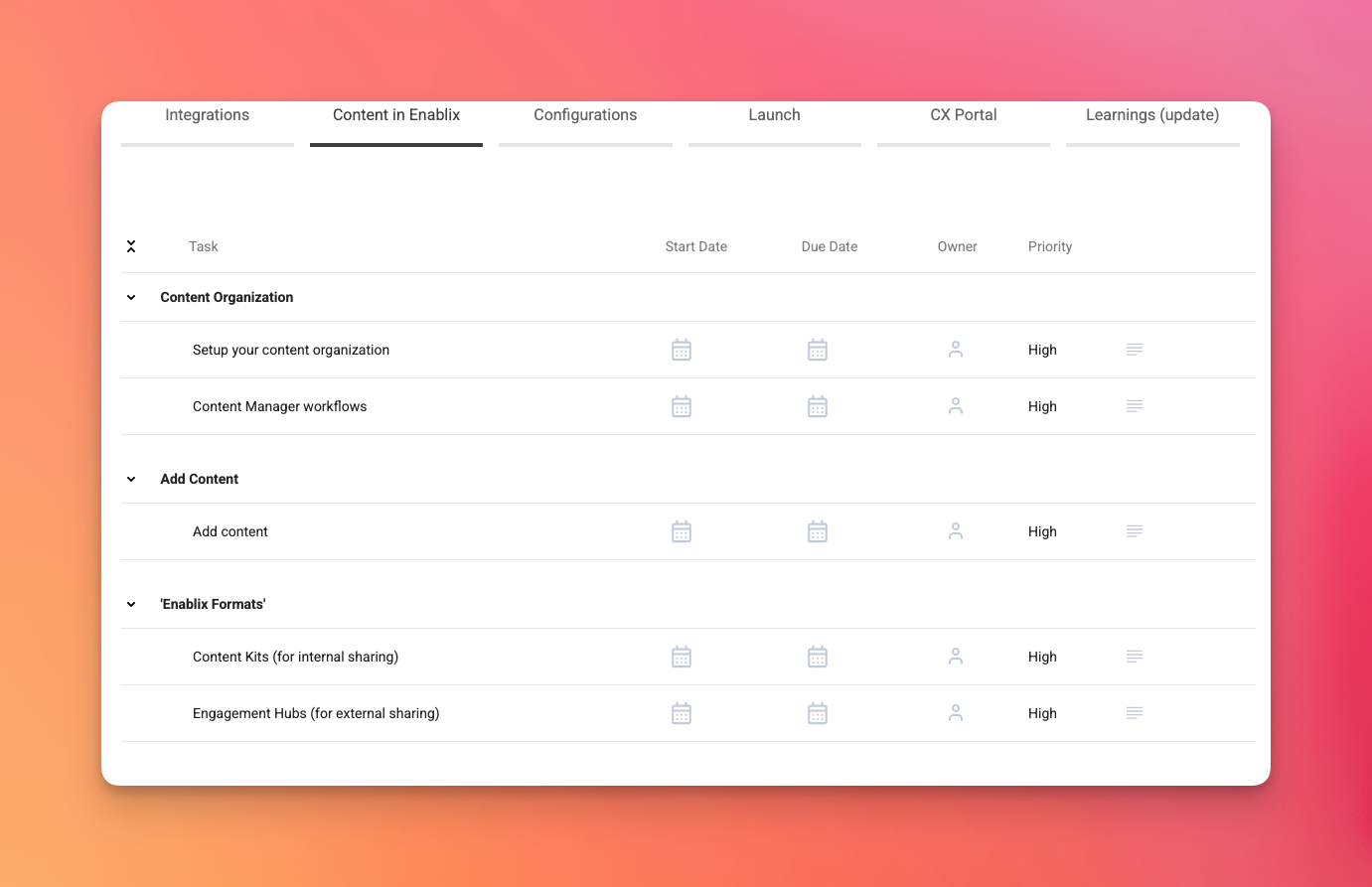
And Sales Enablement solution providers, like Enablix, HighSpot, and Seismic, based their strategy on content. They all supported robust content management capabilities and allowed sales enablement managers and marketers to maintain a library of approved content and resources to get the job done. Here is a snapshot of Enablix’s launch plan that speaks to the importance of content in the Sales Enablement platform setup process.
 And a typical launch training for one of those systems will cover the following topics.
What content is available on the portal
How to find content on the portal
How to find content from the application in CRM or other apps (Outlook, Slack, etc)
How to share content with prospects
How to track prospect engagement
How did sales enablement solutions perform?
Without a sales enablement solution, organizations relied on Sharepoint and Google Drive to organize marketing and sales collateral. These apps are free (part of Office 365 or Google Workspace packages respectively) and practical options to get started. But they are not comparable with sales enablement solutions. We even wrote about it here.
There are clear advantages using a sales enablement solution over cloud storage apps. However, there is a lot of room for improvement. It feels that in spite of all the innovation in the last 10-15 years, the sales enablement solutions have hit a value cap.
Sales rep adoption continues to be a challenge
Sales reps adoption continues to be a challenge across the Sales Enablement Solution industry.

Vendor innovation has not delivered intended outcomes
One of the sought after methods to drive sales adoption is enabling reps in their workflow. Instead of making reps come to the solution, bring the content and knowledge to the apps and systems that reps are using to get the job done. These apps include CRM platforms like Salesforce and HubSpot, messaging tools like Slack and Teams, and email apps like Outlook and Gmail.
In theory, sales enablement managers and stakeholders see the benefit of bringing content to the sales reps. But these investments have not proven beyond demo rooms and meeting conversations. Ask anyone in the industry, and they will tell you that the adoption of these plugins and add-on is anemic.
Governance and resource quality is a challenge
Content governance and quality is vital for a successful sales enablement program. And vendors have delivered features to help enable stakeholders and marketers to govern content library quality. However, content quality continues to be one of the core issues with sales enablement implementations.
Old out of date content continues to exist.
Tagging and labeling is poorly maintained.
Old branded assets linger around.
Sales enablement stakeholders value content quality, but other priorities prevent them from maintaining a hygienic library.
Revenue gaps due to silo’d endeavor
Increasingly organizations are investing not only in Sales Enablement, but also in Revenue Enablement. They are investing in Revenue Enablement. Revenue leaders are tasked to drive retention and expansion among the existing customer base, in addition to acquiring new customers.
However, this holistic approach is not evident in enablement investments.
Sales Enablement investments begin with teams focused on new logo acquisition
While there are plans to bring Customer Success and Account Managers onboard these enablement platforms, those plans remain incomplete due to cost impact
Sales enablement investments are limited to quota carrying account executives and account managers. However, product managers and other stakeholders are not onboarded on these platforms.
A silo’d approach to sales enablement results in internal misalignment, sales productivity loss, and negatively impacts their long term objectives of these investments.
Conclusion
No doubt, Sales Enablements solutions have proven more valuable than cloud storage systems, but there is a lot of room for improvement. However, the system value curve has hit a ceiling. And it is not for lack of trying. These systems are expensive, and revenue leaders have accepted the compromise with capped value they deliver.
The last mile gap
We have operated in the Sales Enablement space for 9 years and have learned a lot through onboarding and supporting our customers. The challenges we discussed in the earlier section are not unique to our competitors. Many of our customers suffer from similar enablement limitations.
We discuss multiple reasons for this sub-optimal outcome, but a key reason is that these systems deliver an incomplete sales enablement solution. Specifically, these systems failed to complete the job for the sales rep.
Sales Enablement platforms, with the then available technology, were architected to be content libraries that,
Helps enablers all types of collateral and information in one place
Tag and organize the content based on business taxonomy
Provide powerful search and discovery techniques to help reps find the right content
Help reps share content with prospects and customers with optimized buyer experiences
Track external and internal engagement to gauge adoption and effectiveness
But sales reps did not need content. They needed outcomes to help them get the job done.
Here are some jobs a typical sales rep performs:
Follow up with a prospect by providing real value
Handle objections and conduct strong discovery
Standout from the competitors with tailored positioning
Communicate value during demos and meeting
Share personalized buyer experiences with digital sales and deal rooms
Respond to prospect’s questions in a timely manner
Content was necessary to help reps get the job done. But content alone did not finish the job.
For instance,
When reps used sales enablement platforms to prepare for an upcoming meeting, they received relevant collateral. But the rep still had to use the content to extract relevant information.
When reps followed up with the prospect, they had to find collateral and extract the necessary information to deliver value to the prospect.
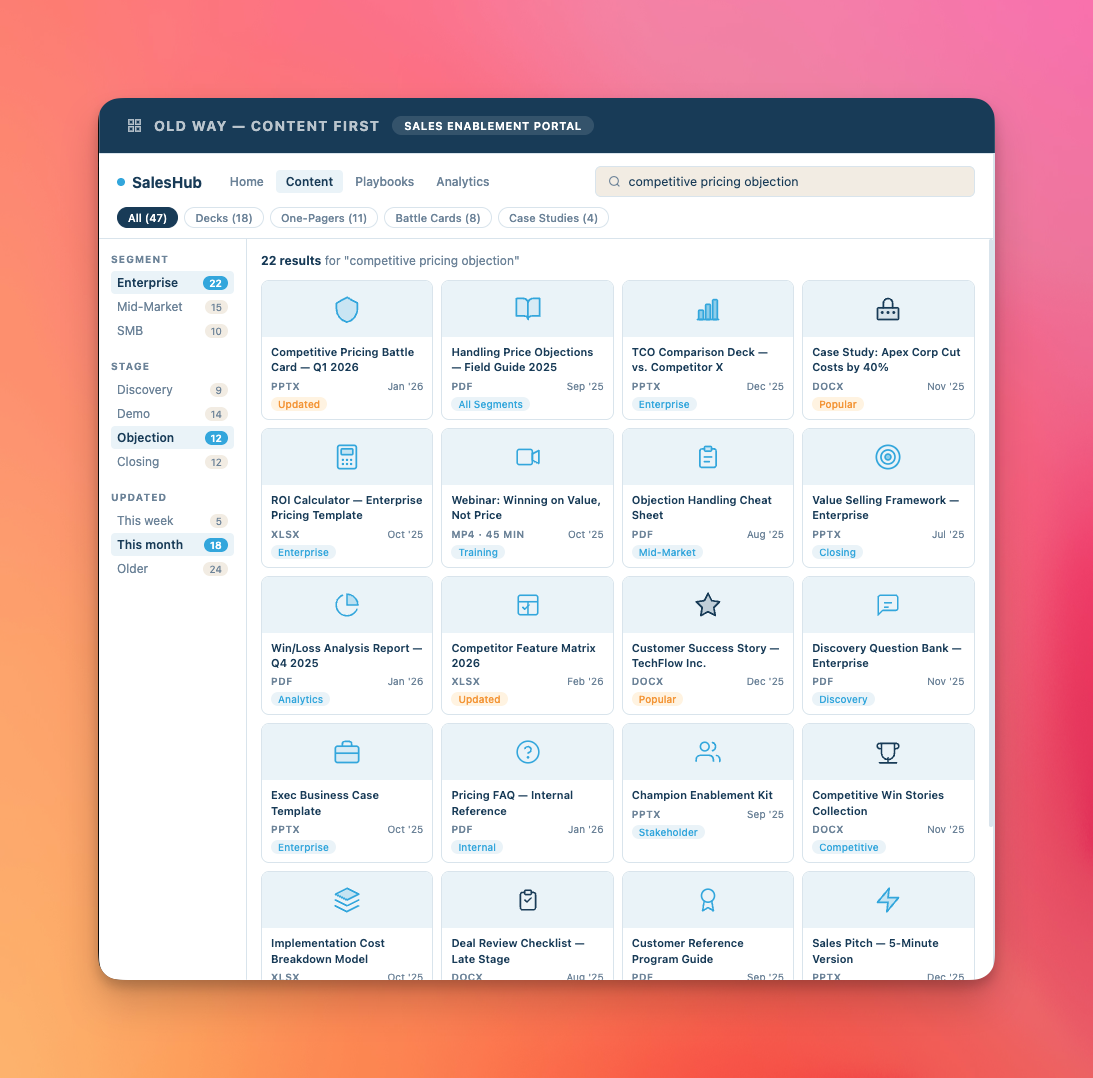
Sales Enablement applications were much better content library systems than Google Drive and SharePoint. But the output was a list of content assets. Whether a rep accessed these systems from the web, or from inside CRM, or in Slack or Teams, the output was always a list of content assets that matched the rep’s search criteria.
These systems did not address the gap between content assets and outcomes. They gave reps the content that matched their search criteria. It was up to the rep to navigate the journey from those content items to the intended outcome. The rep had to figure out what and how they needed to share the insights from these served content assets with their prospects. While it is a last mile problem, it is not an easy problem to solve. Sales reps are naturally inclined to take several content assets and extract the necessary information from these assets to get the job done.
And accessing content from different channels (CRM, Slack, Outlook, etc.) did not lighten the burden on the reps. These different channels end up serving the same content assets similar to the platform.
In the below example a rep needs to position their company’s offering against that of Salesforce as Salesforce is offering a steep discount. The image shows the traditional way to get the job done. Rep searches competitive pricing objections, gets a bunch of assets, and has to put in the effort to scan through the content to get the job done. In many cases, they will simply call their boss or a trusted member of their team to get the job done. The sales enablement solution helped but not all the way.
And these last mile misses add up. A small percentage of reps are rabid users of the platform. Others are average users lurking in the portal but not using it casually. And the rest rarely sign in or find the platform useful. Many enablement stakeholders will tell you that the reps need spoon feeding and are lazy. And they are correct. But it is also true that the traditional sales enablement approach did not finish the job for the sales rep.
Generative AI to rescue
Traditional sales enablement platforms led with content. Content-first was not a bad thing. After all marketers and enablement stakeholders think in terms of content. Content is a natural construct to build an enablement engine. And though sales enablement platforms invested significantly in making this experience work for the sales reps, it could not get the job done for the sales rep. I believe this resulted from technological limitations.
Generative AI unlocks the opportunity to address this last mile gap.
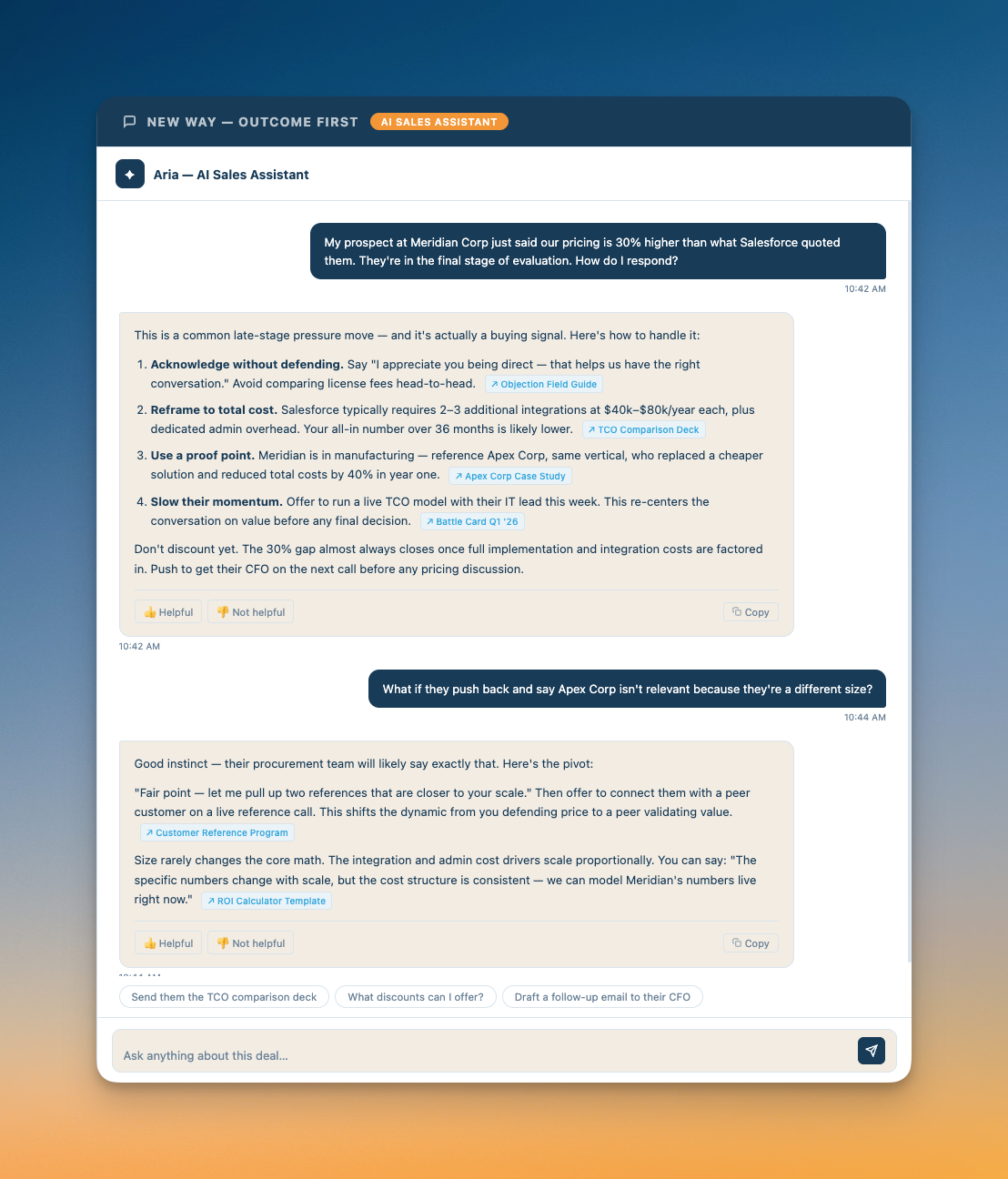
When a rep needs to follow up with a prospect, they do not need content. They need guidance and messaging to help with the follow up. Generative AI makes it possible to extract those insights and help reps get the job done.
In the previous section, we discussed an example where a rep needs to position their company’s offering against Salesforce. We saw how the traditional approach falls short. With Generative AI, modern sales enablement solutions can get the job done. The below illustration shows how the same use case can complete the job for the sales rep. AI can help sales reps with similar jobs to be done to deliver productivity gains and increase their probability to win.
Content is vital
The central point of this post is modern Sales Enablement platforms should lead with enablement outcomes, not enablement content. However, content will continue to play a central role in delivering those outcomes. We are not suggesting that the importance of content is diminished. Enablement stakeholders should continue to invest in content to drive the enablement engine. But the role of content is different.
We are moving to a world where content will be an enabler and not the end all be all in itself. Content will power the answers to help sales get the job done. Content is not going anywhere. It's just that it is shifting to its rightful place.
Extract GTM content intelligence at scale
Context is vital to make use of AI. We built a content intelligence engine to derive that context.
Subscribe to Enablix
Fresh thinking on sales, partner and customer enablement, delivered to your inbox.