AI-Powered Prospecting and AI-Powered Sales Enablement Are Not the Same

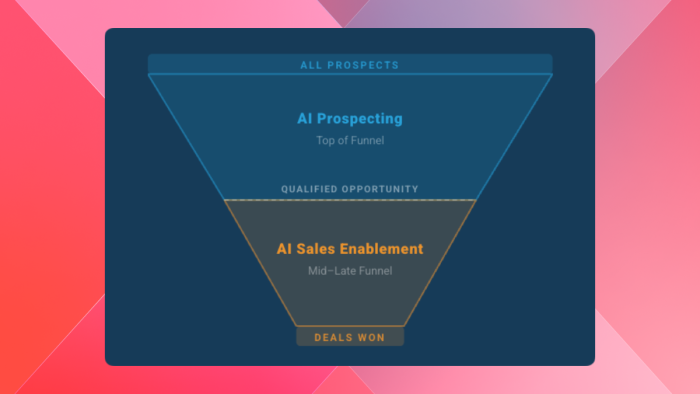
AI prospecting tools automate top-of-funnel outreach to book meetings. AI sales enablement supports reps with qualified leads and active opportunities. They operate at different funnel stages, use different data, and solve different problems. Understanding the distinction helps sales organizations invest in the right tools for the right job.
Key Takeaways
AI prospecting tools and AI sales enablement tools solve different problems at different funnel stages — conflating them leads to the wrong buying decisions.
AI prospecting works with limited public data. AI sales enablement works with rich internal data — call recordings, content libraries, competitive intelligence.
The collateral and messaging used when prospecting is fundamentally different from what is needed in an active sales cycle.
AI prospecting and AI sales enablement are unlikely to converge because they are aligned to different functions and different data sets.
There is a meaningful integration opportunity: content intelligence layers like Clake can make prospecting tools smarter by serving internal context via API or MCP server.
Someone I was exchanging emails with recently asked me a sales enablement industry question: how do we see the sales industry getting disrupted by AI SDRs?
It is a valid question. The term "sales enablement" is generic. It always has been. It gets used as a category label for a specific set of applications — content management systems, training platforms, the likes of Highspot, Seismic, and Enablix. But the label is broad enough that almost anything that helps a sales rep can be called sales enablement.
An AI note-taking app that captures notes in your CRM? You could call that sales enablement. An AI SDR sending personalized outreach at scale? You could call that sales enablement too.
So let me draw a distinction that I think matters.
What AI Prospecting Tools Do
Booking meetings remains one of the biggest challenges in B2B sales. Companies of all sizes struggle with it. AI SDRs address this directly. They pull data from LinkedIn profiles, company websites, and other public sources, and use it to personalize outreach at scale. Every email can be different. That is a real improvement over earlier automation tools.
But the data they work with is limited. It is what is available outside the organization. Public information.
What AI Sales Enablement Does
Once a rep has had an initial conversation with a prospect, everything changes. They now have context. They know the prospect's specific problems, their buying process, who else is involved in the decision. The type of collateral that gets used at this stage is completely different from a prospecting sequence.
AI sales enablement operates at this stage — helping reps with qualified leads and active opportunities. The data it works with is internal. Call recordings, content libraries, customer stories, competitive intelligence. Rich context that no public data source can replicate.
Two Different Stages, Two Different Problems
The way I see it:
AI prospecting is about booking meetings. Top of funnel. Limited data. Personalization at scale.
AI sales enablement is about winning opportunities. Mid and late funnel. Rich internal data. Intelligence at the moment of need.
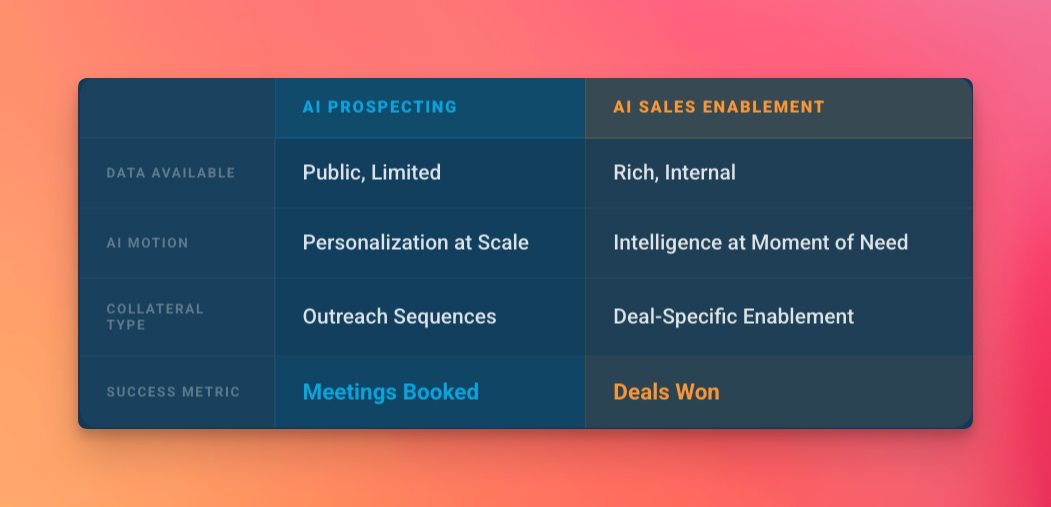
These are aligned to different stages of the sales funnel. The collateral is different. The data is different. The job to be done is different.
I do not see these two tracks converging. Prospecting is a different beast from sales enablement and I think it will stay that way.
Where Integration Makes Sense
That said, there is an integration opportunity worth paying attention to.
Today, SDR managers create outreach sequence templates in advance. Those templates are generic by nature. But what if personalization was powered not just by public data, but by a content intelligence layer that understands your market, your buyers, and your solutions?
SDRs using tools like Gong Engage or ZoomInfo could hyper-personalize outreach using context from a content intelligence engine — served via an API or MCP server. The prospecting tool handles the automation. The content intelligence layer makes the outreach smarter.
That is a meaningful opportunity. But it is an integration point, not a convergence of the two categories.
The Bottom Line
Sales enablement is a generic term and it is getting more generic as AI expands what is possible in the sales process. But generic does not mean everything is the same problem.
AI prospecting and AI sales enablement solve different problems at different stages of the funnel. Understanding that distinction matters — for buyers evaluating tools, and for vendors building them.
Sales Enablement Content to Sales Enablement Outcomes
In an industry tired with content slop, AI can help deliver sales enablement outcomes
Deliver Sales Enablement Outcomes